


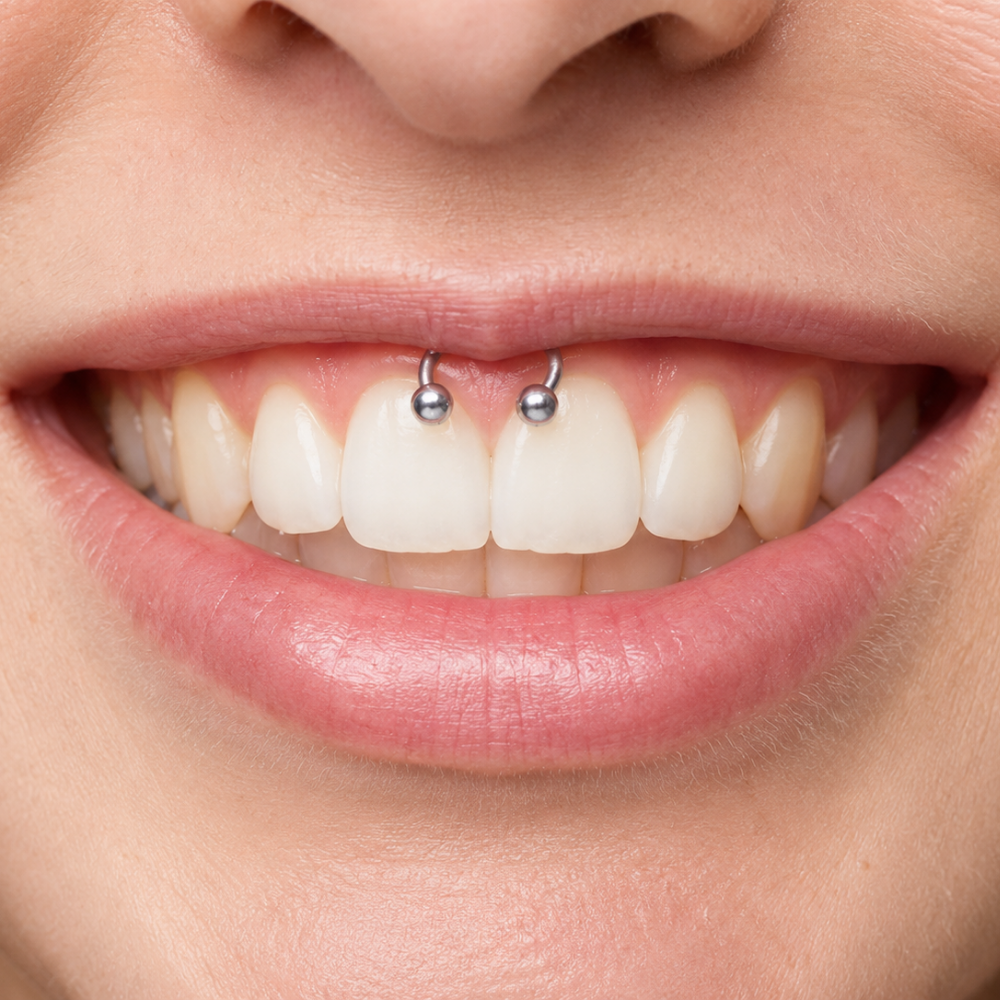
Smiley Piercing
Smiley Piercing this is one of the most original and intriguing piercings in the world of body modifications. It owes its popularity to the surprise effect - when your mouth is closed, the earring is completely invisible, and is only revealed to the world when you smile widely!
Despite its undeniable charm and rapid healing time, Smiley is a specific piercing that requires perfect anatomy and absolute attention to the condition of your teeth. W Piercing Planet we have prepared a complete guide to help you make an informed decision about making a "Smiling Earring".
What is Smiley Piercing?
The treatment involves a horizontal piercing frenulum of the upper lip - this is the thin, small fold of mucous membrane that connects the inside of your upper lip with your gums (just above the gums).
Key point - Anatomy: Not everyone can have this piercing. For Smiley to be possible and have a chance to stay, your frenulum must be thick, flexible and large enough. If the frenulum is very thin like a thread or very short, a professional piercer will refuse to perform the procedure. An attempt to pierce such a microscopic tissue in almost 100% of cases ends with a quick tearing of the frenulum and falling out of the earring!
Does a Smiley piercing hurt?
Smiley is a real favorite for people with a low pain threshold. Due to the fact that only very thin, membranous tissue is pierced without a dense network of nerves or hard cartilage, the procedure is extremely delicate.
Pain is usually rated at only 1 to 2 on a 10-point scale. The process of piercing the needle itself takes a fraction of a second and resembles a light, quick pinch. However, a small, reflex tear may fall from the eye due to irritation of the nasolabial zone.
Healing time and Smiley care
Good news number two: Smiley heals faster than any other body piercing! The mucous membrane in the mouth regenerates at a dizzying pace.
- Initial stage of healing (tenderness): just 1 to 2 weeks.
- Complete healing of the canal: from 3 to a maximum of 6 weeks.
The most important rules:
- Fabric softener is your friend: After each meal and sweet drink, rinse your mouth with sage infusion or a delicate, non-alcoholic dental fluid.
- Be careful with biting: For the first few days, cut sandwiches or apples into small pieces. Catching a fresh piercing with your teeth or food can immediately tear the thin frenulum.
- Brushing your teeth: Be extremely careful when brushing your front teeth (number one and two). Do not scrub the piercing with a brush!
- No "fun": Completely give up the popular habit of moving the earring with your tongue or rolling it with your lip. This is the shortest way to damage the enamel.
What jewelry to wear with Smiley?
Because Smiley "lies" directly on your front teeth and gums, choosing the right shape and the highest quality material is essential.
Jewelry for healing and final use:
The most commonly used and most effective choice is Horseshoe (Circular Barbell) or Ball closed wheel (CBR). If you want the piercing to be completely invisible during healing, the piercer can insert a microscopic Banana (Curved Barbell).
- Safe Tytan G23: The humid environment and constant contact with the enamel mean that the material must be sterile and biocompatible. At Piercing Planet, we only recommend titanium, which does not release harmful nickel and prevents dangerous allergic reactions in the gums.
- Rod Thickness: Very fine jewelry is used in this piercing. It's standard 1.2mm (or even 1.0 mm if the frenulum is particularly delicate).
- Ring/horseshoe size: It must be precisely matched to the distance of the frenulum from the tooth line - usually 8 mm or 10 mm.
Check out our jewelry made of G23 Titanium


- Titanium
- Internal Thread
Titanium Labret with Ball - Internally Threaded
Choose your option


- Titanium
- Internal Thread
Titanium Decorative Labret - Diamond


Choose your option


- Titanium
- Internal Thread
Titanium Rod - Labret With Internal Thread
Choose your option


- Titanium
- Internal Thread
Titanium Decorative Labret - Flat Cubic Zirconia
Choose your option


- Titanium
- Clicker
Titanium Segmented Clicker With Cubic Zirconias Rim - Circle
Choose your option


- Titanium
- External Thread
Titanium Labret With Ball - External Thread

Choose your option


- Titanium
- Internal Thread
Titanium Banana with Balls - Internally Threaded
Choose your option
Smiley Piercing - Questions and Stories
Does Smiley damage teeth and gums?
Does Smiley damage teeth and gums?
This is the most important thing you need to know. Due to its placement, Smiley poses real and high risk for your teeth. The metal ball (or the edge of the circle) rests directly on the numbers. When talking and smiling, the earring rubs against the enamel and front gums, which over time can lead to scratching of the enamel and painful, irreversible recession (slipping) of the gums. This risk can be reduced by wearing smaller, perfectly fitting titanium jewelry, but you should constantly monitor the condition of your teeth at the dentist.
Can the lower frenulum be pierced? (Frowny)
Can the lower frenulum be pierced? (Frowny)
Yes. Piercing the frenulum of the lower lip is the so-called Frowny Piercing (or Anti-Smiley). This is an even more hidden piercing than Smiley. However, it is important to remember that it poses an equally high, and often even higher, risk of damage to the lower gums because the lower lip does much more work when eating and speaking. The anatomy for this piercing can be even more demanding.
What should Smiley's first earring be made of?
What should Smiley's first earring be made of?
The first earring should be made of G23 surgical titanium. It is a safe, light and 100% hypoallergenic material, which minimizes the risk of nickel allergy, which often occurs with surgical steel.


