


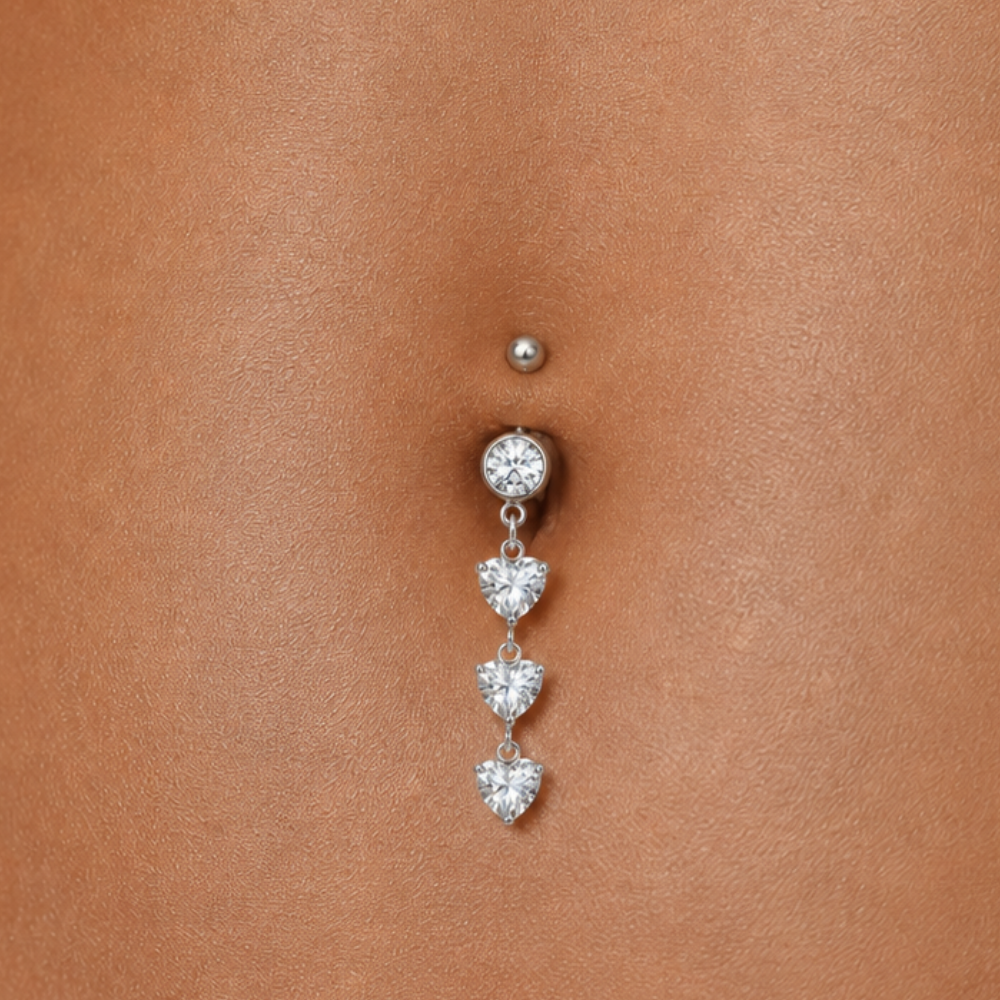
Navel Piercing
Navel piercing it is an absolute pop culture icon that has reigned supreme in the world of piercing since the 1990s. It perfectly highlights the figure, looks great with short tops and on the beach, and the wealth of available jewelry (from modest zircons to hanging, elaborate crystals) allows for full personalization.
Although this piercing is extremely popular, the abdomen is a zone exposed to constant movement, bending and contact with clothes. W Piercing Planet we focus on safety and education, which is why we have prepared a comprehensive guide for you that will help you heal your dream piercing without any problems.
What is Navel Piercing?
One of the biggest myths is the belief that everyone can have a classic belly button piercing. The success of this piercing depends 100% on the structure of your belly!
- Classic Navel: It requires a clear, "roof-shaped" fold of skin above the navel that the piercer can grab. Importantly, when you sit or bend over, your belly button may not close (collapse) completely. If it closes, the lower (large) ball of the piercing will be pushed upwards, quickly leading to painful migration and scarring.
- Floating Navel: This is a rescue for people whose belly button "folds" when sitting down! In this case, the piercing is made a little deeper, and instead of a large ball at the bottom, a flat disk is inserted that hides inside the navel. Thanks to this, the earring is not pushed out and only the beautiful upper decoration is visible from the outside.
Does a navel piercing hurt?
The skin around the navel is relatively soft, but due to its thickness, it requires appropriate determination from the piercer.
The pain is assessed by clients as moderate - usually 3 to 4 on a 10-point scale. The procedure itself is very quick. The piercer will ask you to lie on the couch or remain in a standing position (depending on the technique), he will grab a fold of skin with special forceps (or he will use the technique freehand) and will prick you. Immediately after the treatment, the area may be slightly red and tender.
Healing time and care for Navel Piercing
Your belly is working all the time - you are breathing, bending, laughing, and this means that a navel piercing is considered one of the longest healing piercings on the body.
- Initial stage of healing (tenderness and swelling): from 4 to 8 weeks.
- Complete healing of the wound channel: from 6 to even 12 months!
The most important rules:
- Revolution in the wardrobe: You have to for at least a few months completely give up high-waisted trousers, thick belts and tight leggings that press the navel area. The friction of the material against the earring is the main cause of migration (rejection of the earring) and the formation of granulation tissue!
- Be careful in the shower: Sponges and mesh washers are the biggest enemies of belly button piercings. Getting jewelry caught on a sponge while washing can be extremely painful. Use only your own hands and sterile saline to wash.
- Prohibition of sleeping on the stomach: If you love sleeping on your stomach, you need to change your habits. Pressing a fresh piercing into the mattress will cause it to warp and provoke scarring.
- Gym and activity: You can train, but avoid abdominal exercises (e.g. crunches) and resting weights on this area. Immediately after training, wash the wound to remove sweat!
How to care for a fresh piercing? (Principles of care)
- Don't touch: Avoid touching the earring with dirty hands and refrain from "spinning" it.
- Cleanse regularly: Wash the piercing site 2-3 times a day with sterile saline solution.
- Avoid chemicals: Avoid using hydrogen peroxide, alcohol or antibiotic ointment. They may irritate the wound and delay healing.
- Be careful with your hair and clothes: Make sure that shampoo or conditioner does not remain on the ear after bathing. Be careful when putting on sweaters!
What jewelry for navel piercing?
In such a moving place, there is no room for hardware compromises. Poor quality material that rubs against the waistband of your pants will immediately cause an allergic reaction.
During healing:
The gold standard is curved barbell – Banana (Curved Barbell) with a flat back (for Floating Navel) or classic balls.
- Titanium is the basis: We use and recommend exclusively Surgical Titanium (G23). Surgical steel contains nickel, which often causes allergies in places that take so long to heal.
- Rod Thickness: More stable, thicker jewelry is used in the navel - this is standard 1.6mm (never wear a thin 1.2 mm earring, because under the influence of skin tension it will act like a fishing line and "cut" the tissue!).
- Starting Length: Typically 10mm, 12mm or more to allow room for initial swelling.
Downsize (Shortening the rod): Once the swelling goes down, the rod will start sticking out and catching on your shirts. Replacing the banana with a shorter one that perfectly fits the skin fold is crucial for safe healing.
Decorative jewelry for navel piercing


- Titanium
- Internal Thread
Titanium Navel Piercing - Balls with Zircons
Choose your option


- Titanium
- Internal Thread
Titanium Navel Piercing - Balls
Choose your option


- Titanium
- Internal Thread
Titanium Navel Piercing - Round Zircons


Choose your option


- Titanium
- Internal Thread
Titanium Navel Ring - Cubic Zirconia with Pendant
Choose your option


- Titanium
- Clicker
Titanium Navel Clicker - With Zircons
Choose your option


- 316L steel
- External Thread
Steel Navel Piercing - Heart-Shaped Cubic Zirconia
Choose your option


- Titanium
- Internal Thread
Titanium Navel Piercing - Two Zircons
Choose your option


- 316L steel
- External Thread
Steel Navel Piercing - Star-Shaped Cubic Zirconia
Choose your option
Navel Piercing - Questions and Stories
When can I go into a pool or lake with a belly button piercing?
When can I go into a pool or lake with a belly button piercing?
This is the most frequently asked question in the summer season! Before completely immersing the abdomen in a pool, lake or sea (as well as in a public jacuzzi), you should wait until the initial healing and closure of the canal, which takes at least 2 to 3 months. Water in these places is a huge breeding ground for bacteria, and wetting an open wound often leads to a dangerous infection. At first, limit yourself to showering.
I have a red, raised lump inside my navel (near the lower ball) - what is it?
I have a red, raised lump inside my navel (near the lower ball) - what is it?
It most often appears in the navel for two reasons: wearing clothes that pressurize this place (high-waisted pants) or poor anatomy (the navel "collapses" when sitting down, and the lower belly pushes the lower ball of the earring up). If granulation tissue appears at the bottom, consult your piercer - you probably need a change of jewelry style Floating Navel (with a flat disk at the bottom instead of a large ball).
Can I have a navel piercing during pregnancy?
Can I have a navel piercing during pregnancy?
As the belly grows, the skin on it stretches significantly, which causes the standard titanium piercing to dig into the tissue and may cause stretch marks and migration. Most women take out their jewelry during pregnancy. If your piercing was 100% healed before you got pregnant (you've had it for several years), the canal will probably not heal and you'll be able to put it back in after giving birth. An alternative during pregnancy is to install a flexible, very long bioplastic rod (so-called pregnancy retainer), which will bend with the growing belly.


